
The IMF, in its latest World Economic Outlook report, also said India is among the economies that may require more tightening to address inflation pressure.
The IMF, in its latest World Economic Outlook report, also said India is among the economies that may require more tightening to address inflation pressure.

Alternative Investment Funds (AIFs) with a lock-in period performed better than the ones that allow investors to withdraw capital at any time. Close-ended schemes had a median return of 5.62 per cent in December, according to data from industry tracker PMSBazaar. The median returns for open-ended schemes were 3.91 per cent
.jpg)
Moody's became the first rating agency to retain the sovereign rating of Baa3 for the country after the rupee dived below 63 to the dollar, on Monday.

'They think quick fixes like internship in the private sector will help. 'In fact, internships have been going on for the last one decade.' 'In 2014-2015 itself, we had a ministry of skill development. None of the programmes have yielded results, still they are continuing with such schemes under some other name.' 'We don't see any seriousness on the part of the government to attack the problem of unemployment.'
Advanced economies are projected to grow by just 2.7 per cent in 2010 and 2.2 per cent in 2011, the IMF report said.

Buoyed by healthy farm output and narrowing current account deficit, India is the seventh most economically confident country in the world, a study by global research firm Ipsos has said.

The BJP state unit hailed Vasan and said his advice will be used in the coming days to guide the alliance.

Amid China's economic slowdown, the country's economic challenges may increase manifold and its economy may be hit harder in the wake of the Ukraine-Russia crisis.

'We should look at is full year's growth rather than quarter numbers.'

The indicator, designed to flag turning points in the economic cycle, suggested there was "stable growth momentum" in the bloc of mostly wealthy developed nations, the OECD said.

Fitch Ratings on Monday said the shock to economic activity from the latest wave of COVID-19 pandemic will be less severe than the one in 2020, but recovery is likely to be delayed as economic activity dropped in April-May. The global rating agency said there are growing indications that the latest wave of COVID-19 infections will add to risks among financial institutions (FIs) and anticipates that the Reserve Bank of India (RBI) may introduce additional measures to support the financial sector if indications of economic stress mount.
It forecast a growth of 9 per cent for 2011-12.

The Prime Minister's Economic Advisory Council on Friday said the economy will grow by 8.5 per cent, up from a projected 8.2 per cent, and inflation will come down from double digits to 6.5 per cent by the end of 2010-11.

Gandhi took a swipe at the government on Twitter by tagging a chart that showed IMF growth projections for 2020-21 for Bangladesh, Myanmar, Nepal, China, Bhutan, Pakistan, Sri Lanka, Afghanistan and India.

According to the Grant Thornton International Business Report, 45 per cent of businesses in the BRIC countries (Brazil, Russia, India and China) plan to increase investment in research and development over the next year, compared to just 18 per cent in the G7.

For the 2009-10 fiscal, Pranab said, he expects the economy to grow by 7.2 per cent.

According to the BofA-ML Fund Manager Survey for January, asset allocators assigning more funds to equities than at any time since February 2011, while their confidence in the world's economic outlook has reached its most positive level since April 2010.
Returns from the yellow metal may be subdued, as focus returns to equities.
The panel, headed by former RBI governor C Rangarajan, in its economic outlook for 2007-08 also projected inflation to remain within 4 per cent.
Revising its economic outlook, International Monetary Fund (IMF) today marginally brought down India's growth rate projections to 5.6 per cent for this fiscal and 6.3 per cent for the next financial year.

Lower IT exports will raise India's dependence on capital flows to fund imports.

Since the last nine years, gold investors have made money each year, while gains in silver have been consistent only in the last five years.

The RBI has already hiked interest rates 12 times since March, 2010, to control inflation, which is currently hovering near the double-digit mark.
The Shanghai Stock Exchange has registered maximum fall (56 per cent) from its peak, while the benchmark index of the Bombay Stock Exchange dipped by as much as 40 per cent and the Manila Stock Exchange dropped by 39 per cent, registering the third largest fall. The report added that 'having lost one fifth to one third of their value, equity assets would appear to have greater upside rather than down side prospects.
India can raise funds through selling up to\n49 percent of its state-run firms, Montek Singh Ahluwalia, deputy chairman of the\nPlanning Commission, has said.
India will grow at around 8 per cent this year and next, but the principal risk to this projection stems from the demand-led inflation that "would occur if the total Pay Commission award for government employees were to be paid out immediately," the Paris-based Organisation for Economic Cooperation has warned.Besides, "quick action to write off small farmers' debt would also add substantially to demand," the OECD indicated in its latest Economic Outlook.


The Reserve Bank on Wednesday hiked key benchmark policy rate by 25 basis points to 6.5 per cent, citing sticky core inflation. This is the sixth time interest rate has been hiked by the Reserve Bank of India (RBI) since May last year, taking the total quantum of hike to 250 basis points. Announcing the bi-monthly monetary policy, RBI Governor Shaktikanta Das said the Monetary Policy Committee (MPC) by a majority decided to raise the policy repo rate by 25 basis points and keep a 'strong vigil' on inflation outlook.

Debashis Chatterjee speaks about the overall demand environment and company's strategy

Foreign portfolio investors (FPI) have pulled out $3.5 billion from India's equity markets so far this month. The selling comes on the back of election-induced volatility and the rotation of flows from India to China, where stocks are available at half the valuations. If the selling pressure remains at the current level, this will be the highest FPI pullout since January 2023.
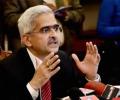
Reserve Bank Governor Shaktikanta Das has pitched for policy support from all sides -- fiscal, monetary and sectoral -- to nurture recovery of the economy hit by the second wave of the coronavirus pandemic. The dent on economic activity due to the second wave of the pandemic during April-May necessitated continuation of monetary measures to support the process of economic recovery to make it durable, Das had said while participating in the meeting of the Monetary Policy Committee (MPC) earlier in the month. "Overall, the second wave of COVID-19 has altered the near-term outlook, and policy support from all sides - fiscal, monetary and sectoral - is required to nurture recovery and expedite return to normalcy," Das said, as per the minutes of the meeting released on Friday.

Asian economies have been very strong in their stimulus from both monetary and fiscal sources.

Among the Sensex firms, JSW Steel, Tata Steel, Tech Mahindra, Infosys, Wipro, Tata Consultancy Services, Nestle, HCL Technologies, HDFC Bank and Maruti were the major laggards. IndusInd Bank, ITC, Bharti Airtel and State Bank of India were among the winners.

The International Monetary Fund on Thursday retained its projection for Indian economic growth at 5.4 per cent in 2009, implying a slower growth in the second half of this calendar year.

The Reserve Bank of India's interest rate decision, macroeconomic data and global trends will drive investors' sentiment this week, with markets hoping to continue the positive momentum after ending FY24 on a buoyant note, analysts said. In addition, the trading activity of foreign investors, the rupee-dollar trend and the movement of global oil benchmark Brent crude would also influence trading in equity markets. The 30-share BSE Sensex climbed 14,659.83 points or 24.85 per cent in the 2023-24.
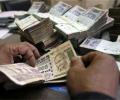
Standard and Poor's raised the outlook for India's "BBB-minus" rating back to "stable" from 'negative,' saying Prime Minister Narendra Modi government's 'strong' mandate would allow it to implement fiscal and economic reforms.

Consumer goods firms and auto companies are witnessing an upturn in rural demand, which had been lagging for most of FY24. Expectations of a bumper rabi crop harvest have helped turn the tide. The Reserve Bank of India's (RBI's) Monetary Policy Committee kept the repo rate unchanged last week, noting that as rural demand catches up, consumption is expected to support economic growth in 2024-25.
